Someone I know recently looked at the bright green form on their refrigerator and said, “Why do I need this ugly piece of paper hanging here?” Fair question. Nobody decorates their kitchen with medical paperwork. But that green sheet is called a POLST, and if you or someone you love has a serious illness, it might be the most important document in the house.

What Is a POLST?
POLST stands for Portable Orders for Life-Sustaining Treatment. According to the Washington State Medical Association (WSMA), POLST helps give seriously ill patients more control over their care by translating their wishes into clear, specific medical orders indicating what types of life-sustaining treatment they want or don’t want during a medical emergency.
The key word there is orders. A POLST is a physician order, signed by both the patient and a qualified clinician, that emergency medical personnel are required to follow. In Washington State, the Department of Health and the WSMA have jointly implemented the POLST program, and according to the WSMA’s POLST FAQ, the Department of Health instructs paramedics to be guided by the POLST form, and only the POLST form, when responding to emergencies outside a medical facility.
Why does that distinction matter so much? Because the default during any emergency is to do everything possible to save your life. The National POLST organization points out that for seriously ill or frail patients, standard life-saving treatments are unlikely to prevent death, and they can be painful and traumatic. As the WSMA FAQ puts it, without a POLST, you will most likely receive all possible treatments whether you want them or not.
What the Form Actually Covers
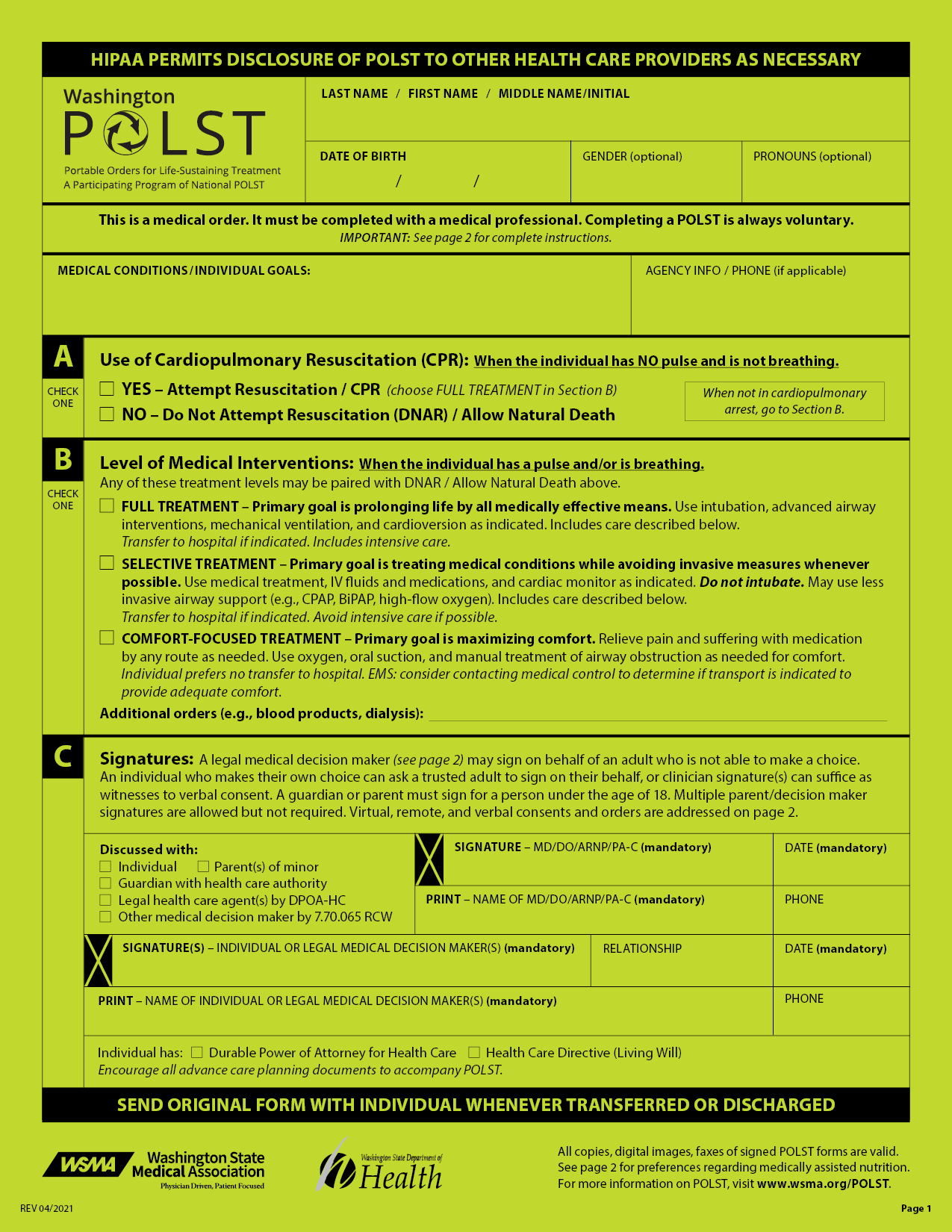
The WSMA explains that the POLST documents decisions about whether to attempt CPR, administer antibiotics and IV fluids, use a ventilator, and provide artificial nutrition by tube. The UW HDSA Center of Excellence also notes that comfort measures and food and fluid by mouth are always provided regardless of other choices on the form.
One common point of confusion: choosing “Do Not Attempt Resuscitation” in Section A doesn’t mean refusing all treatment. According to the WSMA’s clinician guidance, you can check DNAR for cardiac arrest while still choosing Full Treatment for everything else. The form allows for a wide degree of individualization, and your healthcare provider can walk you through exactly what each option means for your specific situation.
PRO TIP: The WSMA advises that if you choose to have CPR attempted (Section A), you should also choose Full Treatment in Section B, since CPR frequently involves intubation and ICU care. These sections work together.
How POLST Differs from an Advance Directive
An advance directive is a legal document that lets you appoint a healthcare decision-maker and provide general guidance about care preferences. Every adult should have one.
A POLST is a medical order. When paramedics arrive at your home, they need specific, actionable instructions they can act on immediately. As CaringInfo (a program of the National Alliance for Care at Home) explains, EMTs cannot honor advance directives or medical powers of attorney in the field, but they must honor a POLST.
Both documents work together. The advance directive speaks for you when you can’t speak. The POLST gives EMS the specific orders they need before anyone has time to search through files. If the two documents ever conflict, the WSMA notes that the more recent document generally takes precedence.
You can find Washington State advance directive forms through the WSMA’s Advance Directives page. A POLST is an additional step for people who are seriously ill or frail. Talk to your healthcare provider about whether you need both.
Who Should Have a POLST?
Most healthy people don’t need one. The WSMA recommends that clinicians ask themselves: “Would I be surprised if this patient died in the next one to two years?” If the answer is no, that person would benefit from a POLST conversation. This generally includes people living with serious chronic conditions, advanced frailty, or a terminal diagnosis, regardless of age.
Completing a POLST is always voluntary. And the WSMA is clear that the form should never be handed to a patient to fill out alone. A POLST should only be completed after a real conversation between the patient (or their surrogate) and a healthcare provider about diagnosis, prognosis, treatment options, and goals of care.
Does It Work?
A 2011 study published in the Journal of the American Geriatrics Society found that POLST orders were consistent with treatments provided 94% of the time across 90 nursing facilities in Oregon, West Virginia, and Wisconsin. A 2024 integrative review analyzing 94 POLST studies found that POLST use was significantly associated with care that matched patient documentation, with the strongest outcomes in the Quality of Care domain.
By comparison, advance directives alone have a much weaker track record. As End of Life Washington notes, healthcare providers frequently don’t follow advance directives, and no state forces a doctor or hospital to do so. Because POLST functions as a medical order, it has proven far more reliable at getting wishes carried out in practice.
Washington State Details Worth Knowing
Washington’s POLST program is jointly run by the Department of Health and the WSMA, rooted in the 1992 amendments to the Natural Death Act (RCW 43.70.480). A few specifics:
The form must be signed by the patient (or their legal surrogate) and a qualified clinician (MD, DO, ARNP, or PA-C). There is no expiration date on the POLST form in Washington, but the WSMA recommends reviewing it when your health status changes or when you transfer between care settings. The WSMA also confirms that copies, faxes, and digital images are all valid. The green paper helps the form stand out, but POLST will be honored on any color.
One important detail for Washington residents: bracelets, necklaces, and wallet cards are not recognized by EMS as valid orders in this state. A bracelet might prompt a first responder to look for the actual form, but Washington paramedics cannot act on directions found on jewelry or pocket cards alone.
While this post focuses on Washington, POLST programs exist across most of the country, though the form goes by different names depending on where you are (MOLST, MOST, POST, and others). According to the American Association of Nurse Practitioners (AANP), 43 states and Washington D.C. have officially recognized programs. The AANP’s State Policy Resource Guide identifies seven states that have not yet adopted an officially recognized statewide form: Alabama, Florida, Kansas, Missouri, Nebraska, Ohio, and Texas. If you have family in another state, you can look up their program through the National POLST state directory.
Why This Matters on Whidbey Island
Island geography adds real weight to these decisions. WhidbeyHealth Medical Center in Coupeville operates a 24/7 emergency department as a Critical Access Hospital, but cases requiring specialized resources may need transfer to mainland facilities via air medical transport.
A clearly visible POLST on the refrigerator or bedside table gives first responders the information they need right away, without phone calls or guesswork. For older residents living alone, and for families coordinating care across the water, having that form ready takes one major question off the table during a crisis.
Clinical nursing services like Whidbey Nurse can help with these conversations too. For patients managing serious illness at home, a nurse who knows your history can help you think through your goals of care and make sure your POLST stays current as things change. These conversations are never easy, but they're always worth having.
Getting Started
If you think POLST might be right for you or someone you love, talk to your primary care provider. You can find the POLST form, patient brochures, and translated versions through the WSMA’s POLST page. The form and brochures are available for free to patients upon request.
PRO TIP: Keep your POLST somewhere visible. The WSMA recommends the refrigerator or a table near your bed. If you’re in a facility, it should be at the front of your medical record. Make sure your family knows where it is.
Thank you so much for reading.
Sincerely,

(your Whidbey Nurse)
This blog post is intended for educational purposes and should not replace personalized medical advice from your healthcare provider.

